Campaigns
One-shot broadcasts to a list or a bucket — commit one with defineCampaign(), or queue one with a single API call. Scheduled with sendAt, cancelable until send, deduplicated per recipient.
Overview
A campaign is a one-time broadcast: a single email template sent to every subscribed member of a list, or every active member of a bucket, at an instant you pick. It has no trigger and no control flow — it fires once and is retired. That makes it the complement to a journey, not a variant of one:
| Journey | Campaign | |
|---|---|---|
| Starts | Per user, on a trigger event | Once, at sendAt (or immediately) |
| Control flow | Full TypeScript — waits, branches, event checks | None: one template, one audience, one instant |
| Audience | Whoever fires the trigger | A list or bucket, resolved at send time |
| Recurrence | Every eligible trigger (per entryLimit) | One-shot; retired after sent |
There are two ways to create one, and they are the same thing underneath — the same campaigns row, the same durable send-campaign task, the same counts and Studio visibility:
- A committed file —
defineCampaign()insrc/campaigns/, picked up by the worker's boot reconciler on deploy. Right when the send is planned: a launch scheduled for Tuesday 16:00 UTC, reviewed in a PR like any other change. - A runtime call —
POST /v1/campaigns,hs.campaigns.send(...), orhogsend campaigns send. Right when the send is decided at runtime: an operator one-off, an agent-driven blast, a button in your own admin.
This guide covers authoring; the Campaigns API reference covers the wire (request/response shapes, statuses, errors), and the Marketing campaigns recipe walks the full define-list → subscribe → broadcast workflow.
Defining a campaign
import { defineCampaign } from "@hogsend/engine";

export const productLaunch = defineCampaign({
  id: "product-launch",                    // stable slug; the retirement key
  name: "Product launch announcement",     // optional, defaults to id
  audience: { list: "product-updates" },   // or { bucket: "power-users" }
  template: "marketing/product-update",    // type-checked against your registry
  props: {
    headline: "Saved views are here",
    ctaUrl: "https://example.com/changelog",
  },
  sendAt: "2026-07-15T16:00:00Z",          // ISO string or Date
});
defineCampaign({ id, name?, audience, template, props?, subject?, from?, sendAt, enabled? }) validates at definition time — the id shape, exactly one of list/bucket, and that sendAt parses to a real instant — and throws on a violation, so a malformed campaign fails at boot, not at send time. Whether sendAt is still in the future is deliberately not checked here; that is a deploy-time question the reconciler answers. The full options table lives in the reference.
The id rules
The id must match /^[a-z0-9_-]+$/i. It is the campaign's retirement key: the reconciler tracks the row as campaign-def:<id>, which is how a sent campaign stays sent across redeploys. Two consequences:
- Renaming the id mints a new campaign. The old row keeps its history; the new id schedules a fresh send. Never rename an id to "edit" a sent campaign.
- A follow-up send is a new id. A campaign is one-shot by design — for the September launch, write a new file (or copy the old one with a new id and
sendAt).
The audience — a list or a bucket
audience is exactly one of { list } or { bucket }, referencing a defined list or defined bucket by id. Both are resolved at send time — members added after the send do not receive it, and members who left are not emailed.
{ list }follows the list's polarity: an opt-in list (defaultOptIn: false) reaches only explicit subscribers; an opt-out list reaches everyone who hasn't unsubscribed. The list id also acts as the send'scategory, so the unsubscribe link in the email unsubscribes from that list.{ bucket }reaches every active member of the behavioral bucket at the moment the campaign runs. A bucket is not a subscription category, so the template's own declared category drives preference checks and the unsubscribe link.
Globally-unsubscribed and suppressed contacts are excluded from both audience kinds, and every individual send re-checks preferences in the mailer as defense-in-depth. Skipped recipients are counted in skippedCount, not emailed.
sendAt — one absolute instant
sendAt is a single absolute instant (ISO string with offset, or a Date) — there is no timezone or send-window logic. Per-user local-time delivery ("9am in each user's timezone") is a journey concern: use ctx.when in a journey instead.
Registering a campaign
A defined campaign does nothing until it is exported from the barrel and threaded into the client. Note the asymmetry versus lists: campaigns goes into createHogsendClient, and createWorker defaults to the container's — you do not pass it again.
1. Export from src/campaigns/index.ts
export { productLaunch } from "./product-launch.js";

import { productLaunch } from "./product-launch.js";

// All defined campaigns for this app, passed to createHogsendClient({ campaigns }).
export const campaigns = [productLaunch];
2. Thread into createHogsendClient
const client = createHogsendClient({
  journeys,
  campaigns, // the reconciler (worker boot) upserts these
  email: { templates },
});

// src/worker.ts — no campaigns option needed; it defaults to the container's
const worker = createWorker({ container: client, journeys });
Only the worker reconciles — the API process carries the definitions on the container but takes no scheduling action, so a scheduled campaign fires exactly once no matter how many API replicas you run.
What happens on deploy
At worker boot, a reconciler upserts each definition into its campaigns row. The behavior is deliberately conservative:
| At reconcile | Outcome |
|---|---|
New definition, sendAt in the future | Created scheduled; delivered at that instant |
New definition, sendAt recently due (within the grace window, default 1h) | Sent on boot — covers a deploy that landed minutes late |
New definition, sendAt staler than the grace window | Created expired with a warning — never a surprise blast |
Still scheduled, file edited | Fields synced; a moved sendAt re-schedules |
Already sent, canceled, or expired | No-op — the row is source of truth; redeploys never resurrect it |
A broken definition — duplicate id, unknown list/bucket, unknown template — is skipped with an error log. Reconciliation never crashes the worker; a typo in a campaign file cannot take down your journeys.
To recover an expired campaign, bump sendAt to a new future instant
(the reconciler only syncs edits while a row is still scheduled, so give
the recovered campaign a new id if the old row already expired). There is no
path by which a campaign committed with last week's date blasts on deploy —
tune the window with CAMPAIGN_DEFINE_GRACE_MS if your deploys are slow.
Sending at runtime
The same campaign, created over the wire instead of committed:
await hs.campaigns.send({
  list: "product-updates",
  template: "marketing/product-update",
  props: { headline: "Saved views are here" },
  sendAt: "2026-07-15T16:00:00Z", // omit to send now
  idempotencyKey: "launch-2026-07",
}); // → { campaignId, status, scheduledAt }hogsend campaigns send --list product-updates --template marketing/product-update \
--at 2026-07-15T16:00:00Z --idempotency-key launch-2026-07
hogsend campaigns list --status scheduled
hogsend campaigns cancel <id>Always pass an idempotencyKey from anything that might retry — a retried create with the same key resolves to the existing campaign instead of a second broadcast. A sendAt more than 60 seconds in the past is rejected with a 400; within the tolerance it degrades to an immediate send. Full request/response shapes are in the reference.
Delivery guarantees
The broadcast runs as a durable Hatchet task in the worker:
- Chunked. Recipients are resolved with keyset pagination and sent in chunks of 100; progress counts flush to the row after every chunk.
- Idempotent per recipient. Each send carries the key
campaign:<campaignId>:<email>, backed by a unique index onemail_sends. A crash or retry re-runs the loop, but already-dispatched sends short-circuit — the retry completes the unsent tail without double-sending anyone. - Self-healing. A reaper cron (every 5 minutes) re-enqueues stalled sends, promotes due
scheduledcampaigns whose punctual run failed to fire, and declares long-stuck campaignsfailedrather than retrying forever. - Cancelable.
POST /v1/campaigns/{id}/cancel(or Studio) cancels ascheduled,queued, orsendingcampaign. Mid-send, delivery stops at the next chunk boundary; dispatched email is not recalled. Completion uses a compare-and-set, so a cancel racing the final chunk is never overwritten. - Tracked. Campaign sends go through the same tracked mailer as every other send — first-party link-click and open tracking,
email_sendsrows, PostHog events — whatever provider is on the wire.
The reaper's timing is tunable per deploy:
| Env var | Default | Controls |
|---|---|---|
CAMPAIGN_DEFINE_GRACE_MS | 3600000 (1h) | How stale a defined sendAt can be at first deploy and still send |
CAMPAIGN_STALE_AFTER_MS | 900000 (15m) | In-flight campaign older than this is re-enqueued |
CAMPAIGN_GIVE_UP_AFTER_MS | 21600000 (6h) | In-flight campaign older than this is declared failed |
CAMPAIGN_PROMOTE_GRACE_MS | 120000 (2m) | Due scheduled row promoted by the reaper after this grace |
CAMPAIGN_REAPER_CRON | */5 * * * * | Reaper cadence |
Studio
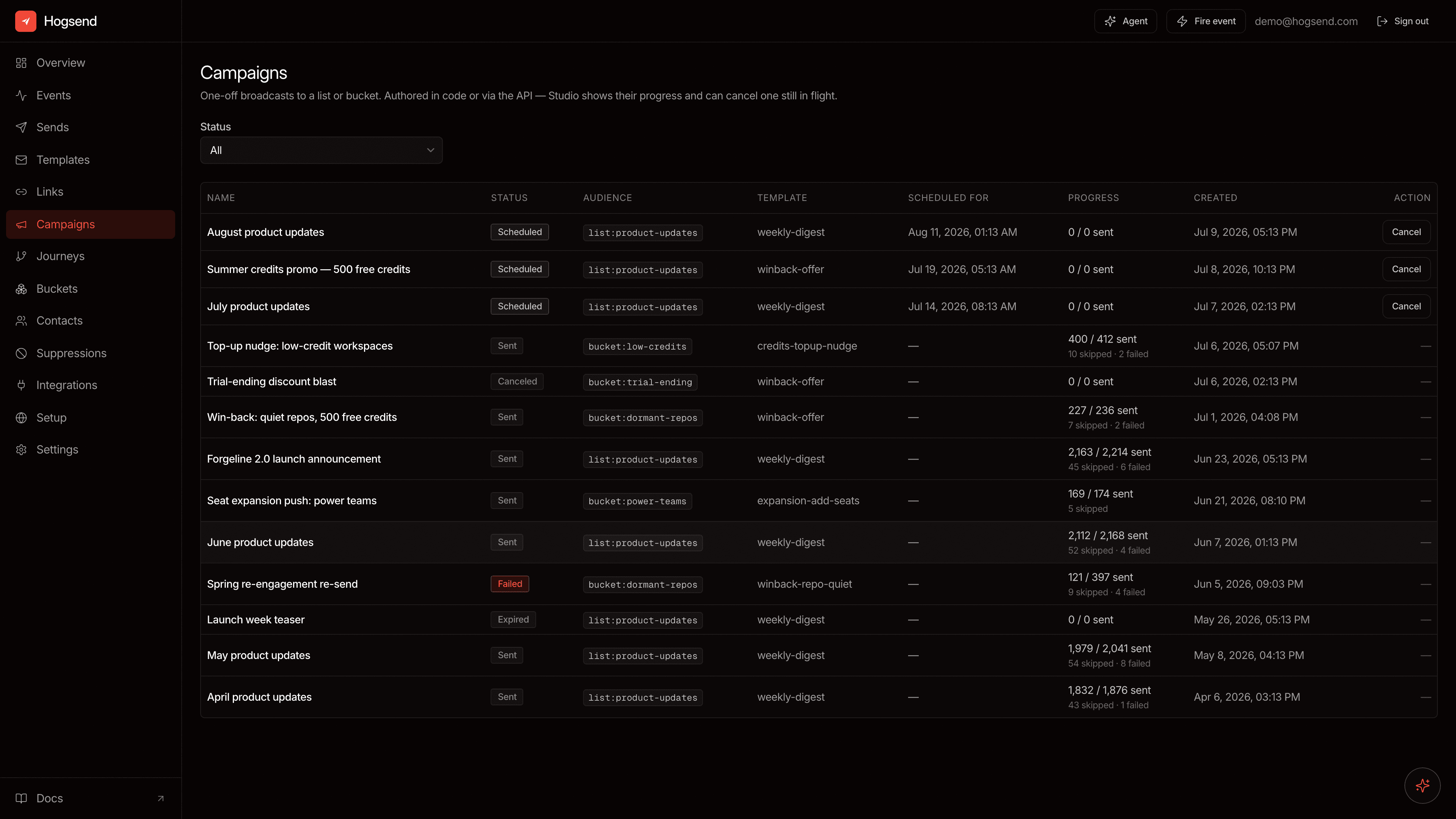
The Studio Campaigns view shows every campaign's status, audience, scheduled time, and live progress counts — sent, skipped, failed — and can cancel anything still in flight. Studio cannot author campaigns; that stays in code or the API, where it can be reviewed.
What a campaign is not
- Not recurring. One
sendAt, one send, retired. A weekly digest is a journey (or a cron task that callshs.campaigns.sendwith a fresh id). - Not personalized per recipient. One template, one
propsobject for the whole audience. Behavior-dependent content is a journey. - Not an ad-hoc recipient list. The audience is a registered list or bucket — that's what keeps unsubscribe enforceable. Import contacts into a list first.
- Not local-time aware.
sendAtis one absolute instant; per-user timing isctx.whenin a journey. - Not recallable. Cancel spares undispatched recipients; email already handed to the provider is gone.
Golden rules
- The id is the retirement key. Renaming it mints a new campaign; a follow-up send is a new id.
- Exactly one of
{ list }or{ bucket }. A list drives the unsubscribe category; a bucket defers to the template's own. - Thread
campaignsintocreateHogsendClient;createWorkerpicks it up from the container. Only the worker reconciles. - A stale
sendAtexpires, never fires. Recover by committing a new future instant. - Anything that might retry passes an
idempotencyKey. The engine already deduplicates per recipient; the key deduplicates the campaign itself.
Lists
Code-defined email subscription categories — declare a list with defineList(), pick its opt-in vs opt-out polarity, and the engine wires suppression, the preference center, and the runtime API automatically.
Conditions
Composable condition engine — check PostHog event properties, user history, and email engagement to control journey behavior.